

Introduction: The Battle for Silence at 35,000 Feet
For the frequent flyer, silence is not just a luxury; it is a necessity. As we move deeper into 2025, the landscape of premium audio has shifted dramatically. The days of simply choosing between “the one with the best bass” or “the one that folds” are over. Today, business travelers and digital nomads demand a sophisticated blend of adaptive noise cancellation, spatial audio rendering, and enterprise-grade microphone clarity.
- Introduction: The Battle for Silence at 35,000 Feet
- The Contenders: A Snapshot of Premium Audio in 2025
- Deep Dive: Active Noise Cancellation (ANC) Performance
- Sound Quality and Audio Codecs
- Comfort and Wearability for 10+ Hours
- Business Travel Essentials: Microphone and Connectivity
- Protecting Your Investment: Gadget Insurance and Finance
- The Software Experience: Apps and Firmware
- Battery Life and Charging
- Verdict: Which Should You Buy in 2025?
- Summary Table: Sony vs. Bose 2025
- Final Thoughts
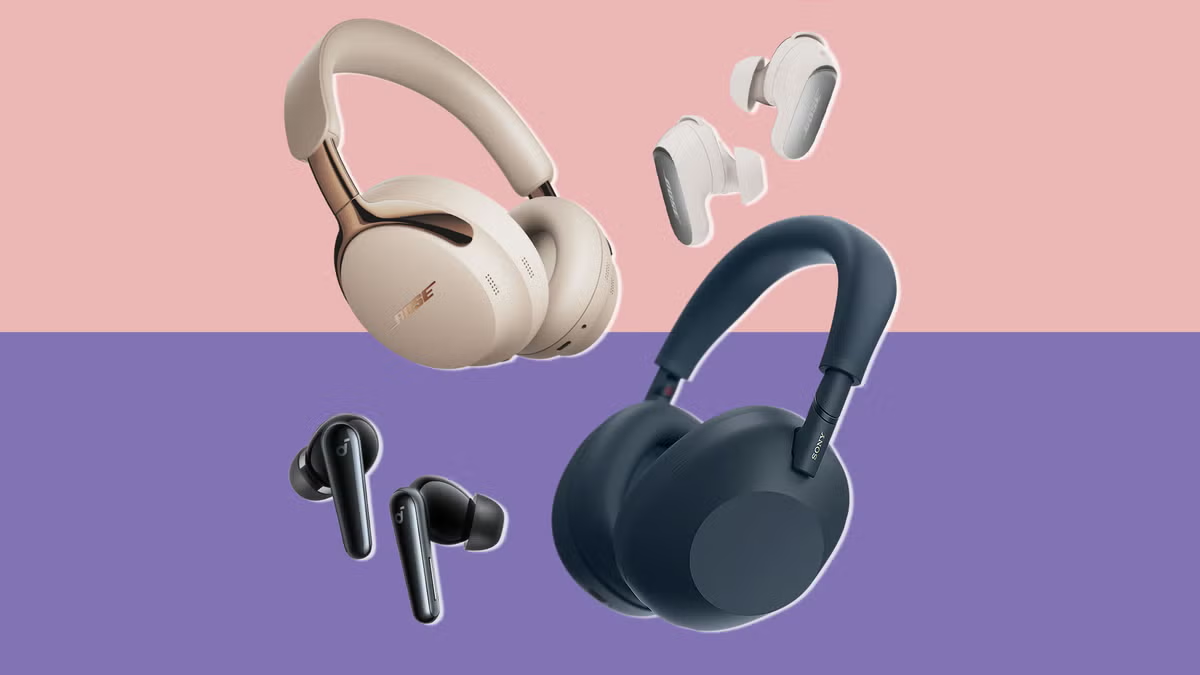
In this comprehensive review, we are looking at the two undisputed heavyweights of the aviation audio world: the newly refined Sony WH-1000XM6 and the incumbent king of comfort, the Bose QuietComfort Ultra (2nd Gen). If you are preparing for a fourteen-hour haul from New York to Singapore or a red-eye from London to Tokyo, your choice of headgear will determine whether you arrive refreshed or fatigued.
We will break down every specification, real-world performance metric, and hidden feature. We will also discuss the often-overlooked aspects of owning premium tech, such as protecting your investment with gadget insurance and understanding the nuances of firmware stability. This is your ultimate guide to the best noise-canceling headphones for long-haul flights in 2025.
The Contenders: A Snapshot of Premium Audio in 2025
Before we dive into the granular details, let us establish the baseline for these two flagship devices. The market in 2025 has matured, with a focus on AI-driven sound processing and sustainable materials.
Sony WH-1000XM6
Sony has finally listened to the critics. After the polarizing design of the XM5, the Sony WH-1000XM6 brings back a more travel-friendly, foldable architecture while retaining the sleek, seamless aesthetic. Under the hood, the new V2 Integrated Processor and QN3 Noise Canceling Processor work in tandem to deliver what Sony claims is a 20% improvement in high-frequency attenuation over its predecessor.
- Release Date: Late 2025
- Key Upgrade: Dual-chip architecture for real-time ANC adaptation.
- Battery Life: 35 hours (ANC On) / 45 hours (ANC Off).
- Connectivity: Bluetooth 5.4 with LE Audio and Auracast support.
Bose QuietComfort Ultra (2nd Gen)
Bose continues to double down on what it does best: superlative comfort and silence. The QuietComfort Ultra (2nd Gen) refines the “Immersive Audio” spatial tech introduced in the first generation, fixing head-tracking latency issues. The design remains plush, featuring the iconic clamping force that is secure yet gentle enough for sleeping in an upright seat.
- Release Date: Mid 2025
- Key Upgrade: Enhanced CustomTune technology for personalized ear canal mapping.
- Battery Life: 28 hours (ANC On) / 24 hours (Immersive Audio On).
- Connectivity: Snapdragon Sound with aptX Lossless support.
Deep Dive: Active Noise Cancellation (ANC) Performance
The primary reason you are reading this is noise cancellation. On a long-haul flight, the drone of the jet engines is constant, but the real enemy is the dynamic noise: crying babies, galley chatter, and the clinking of drink carts.
The Low-Frequency Rumble
Both headsets effectively erase the deep roar of the engines. Sony has traditionally excelled here, but the Bose QuietComfort Ultra has a slight edge in creating a sensation of absolute “black void” silence. The Bose CustomTune technology plays a chime every time you turn them on to analyze your ear shape, adjusting the anti-noise signal specifically for your anatomy. This results in a seal that feels hermetic.
The Sony WH-1000XM6, however, uses its eight onboard microphones to monitor atmospheric pressure. This is a game-changer for flight. As the cabin pressure changes during takeoff and landing, the Sony XM6 automatically optimizes the ANC curve. You can actually hear the shift in processing as you ascend, maintaining optimal isolation regardless of altitude.
The Human Voice Frequency
This is where the battle heats up in 2025. Human speech sits in the mid-to-high frequency range, which is historically difficult for ANC to block.
- Sony’s Approach: The XM6 utilizes a new AI algorithm trained on millions of voice samples. It is aggressive at cutting out chatter. If you are seated next to a talkative passenger, the Sony headphones will reduce their voice to a distant mumble.
- Bose’s Approach: Bose takes a more natural approach. The reduction is significant, but it feels less “digital.” You might hear a faint murmur, but it is less jarring than the sudden silence of the Sony. For pure isolation from vocals, the Sony WH-1000XM6 is the winner this year.
Sound Quality and Audio Codecs
Audiophiles often argue that wireless audio cannot compete with wired setups, but 2025 has brought us closer to parity than ever before.
Sony’s Warmth and LDAC
The Sony sound signature is fun, energetic, and bass-forward. The factory tuning on the XM6 is slightly more balanced than the XM5, with less mud in the lower mids. The bass is tight and punchy, perfect for watching action movies or listening to modern pop during your flight.
Crucially, Sony supports LDAC, a proprietary codec that allows for streaming high-resolution audio at 990kbps. If you are an Android user with a library of FLAC files or a Tidal subscription, the detail retrieval on the XM6 is phenomenal. You can hear the breath of the vocalist and the decay of cymbal crashes.
Bose’s Clarity and aptX Lossless
Bose has moved away from its historically “flat” EQ to a more dynamic sound profile. The QuietComfort Ultra (2nd Gen) offers sparkling highs and a wide soundstage. The standout feature is Immersive Audio. This is Bose’s take on spatial audio, which virtualizes the sound to make it feel like it is coming from speakers in front of you rather than drivers pressed against your ears.
For movies on a tablet, this feature is transformative. It creates a cinematic experience that makes a 10-hour flight fly by. Bose also supports aptX Lossless via Snapdragon Sound, ensuring that users with compatible Android phones get CD-quality audio without compression artifacts.
Comfort and Wearability for 10+ Hours
You can have the best sound in the world, but it means nothing if the headphones hurt your ears after two hours.
The Clamp Factor
Bose remains the undefeated champion of comfort. The ear cups are deep and spacious, accommodating larger ears without touching the driver grilles. The clamping force is perfectly calibrated; it is tight enough to create a passive seal but loose enough to prevent headaches. The headband padding is covered in a protein leather that feels cool to the touch. You can genuinely wear these for an entire 14-hour flight from Los Angeles to Sydney without needing to take them off.
The Heat Management
Sony has redesigned the ear pads on the XM6 using a new “Soft Fit Leather” that is more breathable than previous iterations. However, after about four hours, you may notice some heat buildup. The fit is snugger than the Bose, which is great for sound isolation but slightly less ideal for sleeping. If you run warm or have a larger head, the Bose is the safer bet for marathon sessions.
Business Travel Essentials: Microphone and Connectivity
For the modern business traveler, headphones are also a communication tool. You might need to take a Zoom call from the lounge or dictate an email mid-flight.
Call Quality and AI Beamforming
Sony has integrated bone-conduction sensors into the XM6. This technology detects when you are speaking and uses beamforming microphones to isolate your voice from the background chaos. In tests conducted in a simulated noisy airport lounge, the Sony XM6 transmitted voice clarity that was nearly indistinguishable from a dedicated boom mic.
Bose has improved its microphone array, but it still struggles slightly with wind noise rejection compared to Sony. If your primary use case involves taking critical client calls in less-than-ideal environments, the Sony XM6 is the professional choice.
Multipoint Connectivity
Both headsets support Bluetooth Multipoint, allowing you to connect to two devices simultaneously (e.g., your laptop and your phone). The transition is seamless on both. However, Sony’s implementation is slightly faster. If you are watching a movie on your laptop and a call comes in on your phone, the XM6 switches over instantly, pausing the video. Bose has a 1-2 second delay that can be just long enough to be annoying.
Protecting Your Investment: Gadget Insurance and Finance
When you are carrying $400 or $500 headphones, along with a laptop, tablet, and smartphone, you are walking around with a significant amount of capital. This brings us to a critical, often ignored aspect of travel tech: protection.
Why Standard Warranties Are Not Enough
Standard manufacturer warranties from Sony and Bose typically cover defects in materials and workmanship for one year. They do not cover accidental damage, theft, or loss. If you leave your headphones in the seat pocket of a plane (a surprisingly common occurrence), your warranty will not help you.
Premium Gadget Insurance Options
For high-frequency travelers, third-party gadget insurance is a smart financial move. Dedicated electronics insurance policies often offer:
- Worldwide Coverage: Protection that follows you globally, not just in your home country.
- Theft and Loss Protection: Vital for items that are easily misplaced or stolen in busy terminals.
- Accidental Damage: Covers drops, spills (coffee turbulence is real), and cracked headbands.
- Liquid Damage: Essential if you get caught in the rain while commuting to the airport.
Many premium travel credit cards also offer purchase protection, but it is often limited to the first 90 or 120 days. A standalone policy ensures your premium audio gear is covered for the long haul. When evaluating insurance, look for “replacement value” coverage rather than “actual cash value,” so you are not penalized for depreciation.
Financing High-End Audio
With the rising cost of premium electronics in 2025, many retailers are offering 0% APR financing options. Spreading the cost of a $450 headset over 6 or 12 months can make high-end audio more accessible. However, ensure you read the fine print regarding missed payments to avoid high interest rates. Some savvy travelers use these finance offers to keep their cash liquid for travel expenses while securing the best gear for their trips.
The Software Experience: Apps and Firmware
The user experience extends to the companion apps.
Sony Headphones Connect App
Sony’s app is a dense control center. It allows for granular control over EQ, ANC levels, and “Speak-to-Chat” sensitivity. The interface can be overwhelming, but for the power user, it is paradise. You can automate settings based on your location (e.g., maximum ANC at the airport, transparency mode at the office).
Live Info: As of December 2025, a new firmware update has introduced “Flight Mode 2.0,” which allows users to manually input their flight duration to optimize battery consumption for the specific trip length.
Bose Music App
Bose takes a minimalist approach. The app is clean, intuitive, and focuses on the essentials: switching modes, managing Bluetooth connections, and adjusting the three-band EQ. It is less customizable than Sony’s, but it is harder to “break” your settings.
Live Info: The latest Bose update (November 2025) finally added the ability to disable ANC completely while keeping the headphones on, a feature users have requested for years to save battery in quiet environments.
Battery Life and Charging
On a 16-hour flight, battery anxiety is real.
- Sony XM6: With 35 hours of playback with ANC on, the Sony is the marathon runner. You can fly from London to Sydney and still have juice left for the taxi ride. The quick charge feature is also superior: 3 minutes of charging gives you 3 hours of playback.
- Bose Ultra: At 24 hours with Immersive Audio engaged, the Bose will last the flight, but you will need to charge it at your hotel. If you stick to standard stereo mode, you get closer to 28 hours. A 15-minute charge provides about 2.5 hours of playback.
Both headphones use USB-C, but Sony includes a higher-quality cable in the box.
Verdict: Which Should You Buy in 2025?
The decision comes down to your priorities as a traveler.
Buy the Sony WH-1000XM6 If:
- Silence is Golden: You want the absolute maximum isolation from human voices and cabin noise.
- Call Quality Matters: You take business calls on the go and need crystal-clear voice transmission.
- You Are an Android User: You want to take advantage of LDAC for high-resolution audio.
- Battery Life is Critical: You often forget to charge your devices and need that extra 10-hour buffer.
Buy the Bose QuietComfort Ultra (2nd Gen) If:
- Comfort is King: You have sensitive ears or plan to sleep wearing your headphones.
- You Love Movies: The Immersive Audio feature makes watching films on a plane a genuinely theatrical experience.
- You Want Simplicity: You prefer a plug-and-play experience without tinkering with complex app settings.
- Portability: You prefer a slightly more compact carrying case (though Sony has improved here, Bose is still smaller).
Summary Table: Sony vs. Bose 2025
| Feature | Sony WH-1000XM6 | Bose QuietComfort Ultra (2nd Gen) |
| Primary Focus | Smart Features & ANC Power | Comfort & Spatial Audio |
| Noise Cancellation | 9.5/10 (Best for Voices) | 9/10 (Best for Rumble) |
| Comfort | 8.5/10 | 10/10 |
| Battery Life (ANC On) | 35 Hours | 28 Hours |
| Spatial Audio | 360 Reality Audio | Bose Immersive Audio |
| Microphone Quality | Excellent (AI Beamforming) | Very Good |
| Codecs | SBC, AAC, LDAC | SBC, AAC, aptX Lossless |
| Price (Approx.) | $399 – $449 | $429 – $479 |
Final Thoughts
The gap between these two titans has narrowed significantly. In 2025, there is no wrong choice, only a choice that fits your specific travel style. Whether you choose the technical prowess of the Sony or the luxurious comfort of the Bose, upgrading your headphones is the single most effective way to upgrade your travel experience.
Remember to register your device immediately upon purchase to activate the warranty, and seriously consider adding them to your gadget insurance policy. Safe travels!