

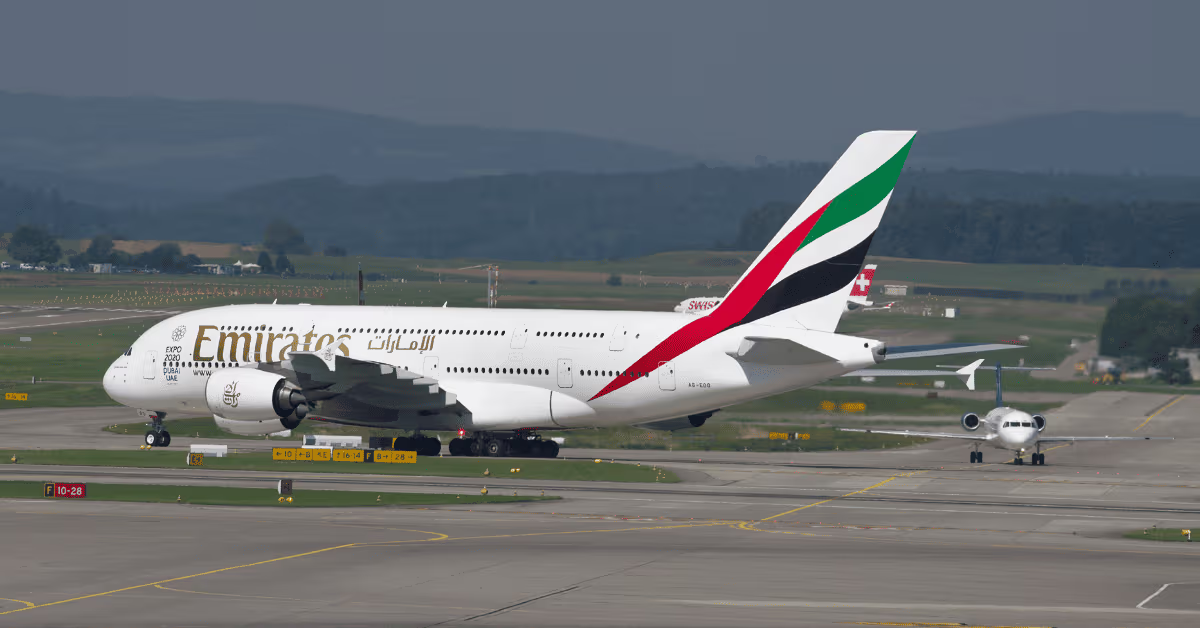
The modern travel landscape is increasingly unpredictable. If you have recently found yourself stranded at an airport terminal, staring blankly at a departure board filled with “CANCELLED” or “DELAYED” notices, you are far from alone. In early December 2025 alone, we have witnessed significant disruptions across Europe, from the massive software update grounding Airbus A320 fleets to the chaotic strikes paralysing transport in Italy and the sudden IT failure at Edinburgh Airport. These events serve as a stark reminder that even the most carefully planned itinerary can fall apart in seconds.
- The Legal Foundation: Understanding Regulation (EC) No 261/2004
- Financial Entitlements: Calculating Your Claim Value
- Short Haul Flights (Up to 1,500 km)
- Medium Haul Flights (1,500 km to 3,500 km)
- Long Haul Flights (Over 3,500 km)
- Eligibility Criteria: When Can You File a Claim?
- The “Extraordinary Circumstances” Defence
- Live Updates: Recent Flight Disruptions and Your Rights (December 2025)
- The Airbus A320 Software Crisis
- Italian Transport Strikes (Nov/Dec 2025)
- Edinburgh Airport IT Failure (Dec 5, 2025)
- Step by Step Guide to Filing Your Claim
- Phase 1: Evidence Collection at the Airport
- Phase 2: The Letter Before Action
- Phase 3: Handling Rejections and Legal Escalation
- Phase 4: Legal Representation and Claim Agencies
- The Right to Care: Additional Reimbursements
- Maximising Your Settlement: Expert Tips
- Frequently Asked Questions (FAQ)
- Conclusion
However, amidst the frustration of lost time and ruined plans, there is a powerful legal remedy available to you. Regulation (EC) No 261/2004, commonly known as EU261, serves as the gold standard for passenger rights globally. It is not merely a set of guidelines but a robust legislative framework that entitles you to substantial financial reimbursement—up to €600 per passenger—when airlines fail to deliver on their service contracts.
This comprehensive guide is written from the perspective of an industry insider. We will dissect every clause of the regulation, analyse recent legal precedents regarding “extraordinary circumstances,” and provide you with an actionable, step by step roadmap to securing the payout you deserve. Whether you are a business traveller missing a crucial meeting or a family losing days of a holiday, understanding your legal entitlement to indemnity is the first step toward justice.
The Legal Foundation: Understanding Regulation (EC) No 261/2004
To effectively claim compensation, one must first understand the statute that grants these rights. Enacted by the European Parliament and Council in February 2004, this legislation was designed to dissuade airlines from the practice of overbooking and to penalise them for operational mismanagement that results in severe delays or cancellations.
Jurisdictional Scope
The regulation applies to a wide array of flight paths, but it is not universal. Eligibility is determined by your departure point and the nationality of the airline. You are protected under these laws if:
- Your flight departs from any airport located within an EU Member State (plus Iceland, Norway, or Switzerland), regardless of the airline’s nationality.
- Your flight arrives at an EU airport from a non EU country, provided the flight is operated by an EU licensed carrier.
It is crucial to note that following Brexit, the United Kingdom adopted these provisions into domestic law as “UK261.” Therefore, flights departing from the UK or arriving in the UK on a UK or EU carrier generally hold the same weight in terms of consumer protection and right to redress.
Financial Entitlements: Calculating Your Claim Value
The amount of financial restitution you can claim is strictly defined by the distance of your journey and the duration of the delay upon arrival at your final destination. It is not based on the price of your ticket. A passenger flying on a low cost carrier for €50 is entitled to the same €250 compensation as a business class passenger on the same route if the flight is cancelled.
Short Haul Flights (Up to 1,500 km)
For flights covering a distance of up to 1,500 kilometres, such as London to Paris or Berlin to Milan, the statutory compensation is set at €250 (or £220 under UK law). This applies if your arrival is delayed by three hours or more, or if your flight is cancelled without adequate notice.
Medium Haul Flights (1,500 km to 3,500 km)
For intra Community flights of more than 1,500 kilometres, or for other flights between 1,500 and 3,500 kilometres (e.g., Manchester to Marrakech or Frankfurt to Moscow), the compensation increases to €400 (approx. £350).
Long Haul Flights (Over 3,500 km)
For all other flights not falling under the previous two categories, typically intercontinental routes like London to New York or Paris to Tokyo, passengers are entitled to €600 (approx. £520). There is a minor caveat here: if the delay is between three and four hours, the airline may reduce this amount by 50%. However, for cancellations or delays exceeding four hours, the full amount is payable.
Eligibility Criteria: When Can You File a Claim?
Possessing a ticket does not automatically guarantee a payout. The specific circumstances of your disruption are the primary drivers of your legal case.
Denied Boarding and Overbooking
Airlines frequently sell more tickets than there are seats on the aircraft, anticipating that a certain percentage of passengers will not show up. When this calculation fails and you are involuntarily denied boarding, this is considered a “cancellation” for the purpose of the regulation. You are immediately entitled to compensation unless you volunteer to surrender your seat in exchange for benefits.
Flight Cancellations
If your flight is cancelled, you have a right to reimbursement or re routing. Additionally, you are entitled to statutory compensation unless the airline informed you of the cancellation at least 14 days before the scheduled departure date.
- 7 to 13 days notice: You can claim if you are not offered a new route that departs no more than two hours early and arrives less than four hours late.
- Less than 7 days notice: You can claim if the new route departs more than one hour early or arrives more than two hours late.
Tarmac Delays and Long Delays
While the original text focused on cancellation and denied boarding, landmark court rulings (Sturgeon v Condor Flugdienst) have established that long delays are legally equivalent. If you arrive at your final destination more than three hours after the scheduled time, and the delay is within the airline’s control, you have a valid claim for financial indemnity.
The “Extraordinary Circumstances” Defence
The most common reason airlines reject claims is by citing “extraordinary circumstances” under Article 5(3). This legal term refers to events that could not have been avoided even if all reasonable measures had been taken. However, airlines often overuse this defence to avoid liability. It is vital to distinguish between genuine force majeure and operational failures.
What Counts as Extraordinary?
- Political Instability: Acts of terrorism, sabotage, or civil unrest that make flying unsafe.
- Meteorological Conditions: Volcanic ash clouds, hurricanes, or severe snowstorms that close airports or make flight operations impossible.
- Air Traffic Control (ATC) Restrictions: If a strike by ATC staff or a closure of airspace dictates a delay, the airline is not liable.
- Hidden Manufacturing Defects: A defect revealed by the manufacturer that necessitates the grounding of a fleet (like the recent software issues with specific Airbus models) can be considered extraordinary.
What is NOT Extraordinary?
- Technical Faults: Routine mechanical failures, such as a broken landing gear sensor or engine trouble, are considered inherent to the normal exercise of the airline’s activity. The European Court of Justice has ruled repeatedly that maintenance issues are within the airline’s control.
- Crew Sickness: If a pilot or flight attendant calls in sick, it is the airline’s responsibility to have standby crew available. This is an operational issue, not an extraordinary circumstance.
- Airline Staff Strikes: While ATC strikes are extraordinary, strikes by the airline’s own workforce (pilots, cabin crew, ground handlers) are considered within the airline’s management and are therefore eligible for compensation claims.
Live Updates: Recent Flight Disruptions and Your Rights (December 2025)
To illustrate how these rules apply in real time, let us examine the events shaking the aviation industry this week. These “live” examples highlight the difference between eligible and ineligible claims.
The Airbus A320 Software Crisis
In early December 2025, Airbus issued an urgent safety alert regarding a software anomaly in the flight control systems of the A320 family. This led to emergency groundings and software patches globally.
- Analysis: If your flight was cancelled because the specific aircraft required this mandatory safety update ordered by aviation safety regulators, the airline will likely argue this is a “hidden manufacturing defect” or a safety instruction beyond their control. This would likely be classified as an extraordinary circumstance, meaning no cash compensation, although the “right to care” (hotels, meals) still applies.
Italian Transport Strikes (Nov/Dec 2025)
A massive 24 hour general strike in Italy affected airports including Rome Fiumicino and Milan Malpensa.
- Analysis: If the strike involved airport baggage handlers or security staff (third parties), it is extraordinary. However, if the strike was specific to an airline’s own Italian workforce (e.g., Alitalia or ITA Airways staff striking over internal pay disputes), you might have a case for compensation.
Edinburgh Airport IT Failure (Dec 5, 2025)
Flights were suspended due to a failure in the Air Navigation Solutions system.
- Analysis: This is an Air Traffic Control or airport infrastructure failure. Since the airline does not own the airport’s IT system, this is outside their control. Cash compensation is unlikely, but airlines must still provide you with food, refreshments, and accommodation during the wait.
Step by Step Guide to Filing Your Claim
Successfully securing your payment requires a methodical approach. Airlines act as large financial institutions in these matters, often relying on bureaucracy to deter claimants. Follow this professional legal workflow to maximise your chances.
Phase 1: Evidence Collection at the Airport
The strength of your claim is built on the evidence you gather immediately after the disruption.
- Retain Documents: Keep physical or digital copies of your boarding pass, e-ticket, and booking confirmation.
- Photograph the Boards: Take a picture of the departure board showing the delay or cancellation status.
- Ask for the Reason: Request a written statement from the gate agent explaining the cause of the delay. If they refuse, note down the name of the staff member and the time of the conversation.
- Save Receipts: If you incur expenses for food, taxis, or hotels, keep itemised receipts. Credit card statements are often rejected; you need the actual bill.
Phase 2: The Letter Before Action
You must first submit a formal claim directly to the operating airline. Do not use the marketing contact form; look for the dedicated “EU261 Claim” or “Legal Department” address. Your correspondence should be professional, concise, and cite the regulation.
Drafting Tip: clearly state: “I am claiming compensation under Regulation (EC) 261/2004 for flight [Number] on [Date], which was [cancelled/delayed] for [Number] hours. The distance was [Number] km, entitling me to €[Amount].”
Phase 3: Handling Rejections and Legal Escalation
It is standard practice for some airlines to use automated systems to reject initial claims, citing generic “operational reasons” or “weather.” Do not accept this as final.
- Demand Proof: If they claim extraordinary circumstances, ask for the specific flight log or weather report that proves it.
- ADR Schemes: Many airlines are signed up to Alternative Dispute Resolution (ADR) bodies. If the airline rejects your claim, you can escalate it to the relevant ADR entity (e.g., AviationADR or CEDR in the UK). Their decision is binding on the airline.
- National Enforcement Bodies (NEB): If no ADR is available, you can file a complaint with the NEB of the country where the incident occurred (e.g., the Civil Aviation Authority in the UK or LBA in Germany).
Phase 4: Legal Representation and Claim Agencies
If the airline stonewalls you, you have two remaining options.
- Hire a Solicitor: You can instruct a lawyer specialising in aviation consumer law to file a court summons. This effectively forces the airline to respond legally.
- Claim Management Companies: There are numerous agencies that will handle the entire process for a “success fee” (typically 25% to 30% of the payout). While this reduces your total net gain, it removes the administrative burden and leverage their legal teams to fight complex rejections.
The Right to Care: Additional Reimbursements
Beyond the fixed compensation sums, Article 9 of the regulation imposes a strict “duty of care” on airlines during the delay itself. This is separate from the cash payout and applies even during extraordinary circumstances.
If you are waiting for a delayed flight, the airline must provide:
- Meals and Refreshments: In reasonable relation to the waiting time.
- Communication: Two free telephone calls, emails, or faxes.
- Accommodation: If the delay necessitates an overnight stay, the airline must provide a hotel room and transport between the airport and the hotel.
If the airline fails to provide these (e.g., there are no staff available), you have the legal right to book reasonable accommodations and meals yourself and claim the costs back later. Note the word “reasonable”—booking a five star presidential suite will likely lead to a refusal of reimbursement, but a standard airport hotel is fully recoverable.
Maximising Your Settlement: Expert Tips
To ensure you receive the highest possible settlement, consider these professional insights.
Check Codeshare Flights
In modern aviation, you often book with one airline (e.g., United Airlines) but fly on a partner metal (e.g., Lufthansa). The regulation applies to the operating carrier. If you booked with an American carrier but the flight departing Europe was operated by a European partner, you are eligible. Always file your claim against the airline that actually flew the plane.
Statute of Limitations
Do not assume it is too late to claim for a past disruption. The time limit for bringing a claim depends on the country where the case would be heard.
- United Kingdom: 6 years.
- Germany: 3 years.
- Italy: 2 years.
- Spain: 5 years.This means you can review your travel history from several years ago. If you experienced a significant delay in 2020 or 2021 that was not clearly Covid related, you might still have a valid claim worth hundreds of Euros.
Travel Insurance vs. EU261
Many travellers instinctively turn to their travel insurance provider first. However, insurance policies often have an “excess” or “deductible” fee, and claiming might increase your future premiums. EU261 compensation is a statutory right with no deductible. It is generally advisable to pursue the EU261 claim first. You can then use your travel insurance for consequential losses not covered by the regulation, such as pre booked non refundable hotels or missed concert tickets.
Frequently Asked Questions (FAQ)
Q: Can I claim compensation for a missed connecting flight?
A: Yes, this is a crucial area of the law. The Court of Justice ruling in Air France v Folkerts determined that the delay is measured at your final destination. If a small delay on the first leg causes you to miss a connection and arrive at your final destination more than three hours late, you can claim for the entire journey, provided the flights were booked under a single reservation reference.
Q: The airline offered me a voucher instead of cash. Should I take it?
A: You should be very cautious. The regulation explicitly states that compensation must be paid in cash, by cheque, or bank transfer. Vouchers or air miles can only be used with your signed agreement. Airlines often push vouchers because they expire and force you to spend money with them again. Unless the voucher value is significantly higher than the statutory cash amount (e.g., an €800 voucher vs. €600 cash), it is usually financially superior to insist on the bank transfer.
Q: Does the ticket price affect my compensation?
A: No. A passenger on a “basic economy” ticket has the exact same rights as a passenger in First Class regarding the fixed compensation amounts (€250, €400, €600). However, the “duty of care” (food/hotel) might vary slightly in quality based on availability, but legally, the protection is universal.
Q: Can I claim on behalf of my family?
A: Yes. One passenger can submit a claim for all passengers on the same booking reference. You will usually need to attach a simple signed authority letter from the other adult passengers giving you permission to handle the funds on their behalf. For minors, the parent or legal guardian can file the claim.
Q: What if the airline says the delay was due to “technical difficulties”?
A: Do not accept this excuse. In the case of Huzar v Jet2, the court clarified that technical problems are inherent in the running of an airline. Unless the technical fault was caused by an act of sabotage or a manufacturing defect that grounded the entire fleet (like the Boeing 737 MAX or the recent Airbus A320 software order), a standard mechanical breakdown is eligible for compensation.
Q: My flight was delayed on the tarmac for 4 hours. What are my rights?
A: Tarmac delays are particularly egregious. In the EU, if a tarmac delay exceeds one hour, the airline must provide air conditioning, lavatories, and water. If it exceeds five hours, you have the right to disembark and cancel your journey with a full refund. For the purpose of compensation, the “arrival time” is defined as the moment the aircraft doors are opened at the destination, not when the wheels touch the ground.
Conclusion
Navigating the aftermath of a cancelled flight can be stressful, but knowledge is your most potent asset. The protections afforded by Regulation (EC) 261/2004 are among the strongest in the world, shifting the balance of power from the corporate giants back to the individual consumer. By understanding the nuances of eligibility, rejecting invalid “extraordinary circumstance” defences, and following a rigorous claims process, you can ensure that you are not left out of pocket.
As we move through the winter travel season of late 2025, with its potential for strikes and technical disruptions, keep this information accessible. Whether you choose to pursue the claim independently or engage professional legal assistance, the law is on your side. Do not leave money on the table that is rightfully yours. Check your past flights, gather your documents, and assert your rights today.