

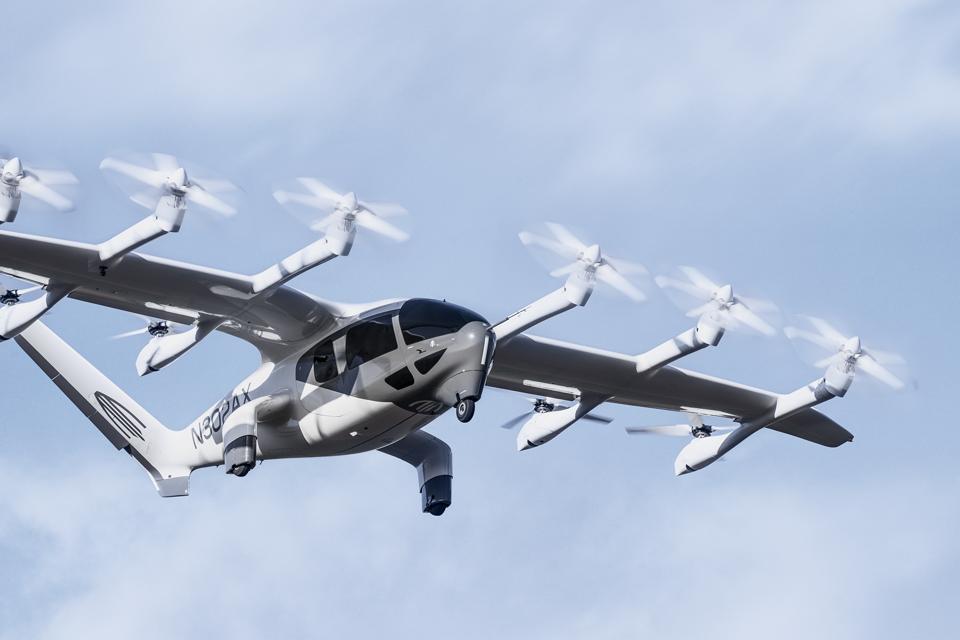
Imagine landing at JFK International Airport after a long international flight. You grab your bags and walk past the taxi queue that stretches for miles. You bypass the train platform crowded with commuters. Instead you head to a dedicated “Vertiport” terminal where a sleek electric aircraft awaits. Within minutes you are airborne, gliding silently over the gridlocked Van Wyck Expressway. Seven minutes later you touch down in downtown Manhattan. This is not science fiction. This is the reality of Electric Vertical Takeoff and Landing (eVTOL) aircraft, and it is reshaping the global investment landscape for urban mobility.
- The End of Traffic: Why Urban Air Mobility Is the Next Gold Rush
- Key Industry Players and Strategic Partnerships
- Joby Aviation and Delta Air Lines
- Archer Aviation and United Airlines
- Vertical Aerospace and The European Market
- The Struggles of Lilium
- Regulatory Milestones: The FAA and EASA Roadmap
- The Economics of Flight: Cost Per Mile and Ticket Pricing
- Infrastructure: The Rise of Vertiports
- Investment Outlook: Where the Money Is Flowing
- Future Projections: 2030 and Beyond
As we move through 2025 the promise of Advanced Air Mobility (AAM) is transitioning from prototype to product. Major airlines like United Airlines and Delta Air Lines are betting billions on this technology to solve the “last mile” problem of airport travel. For investors and tech enthusiasts alike the rise of electric air taxis represents one of the most significant shifts in transportation since the jet engine.
The End of Traffic: Why Urban Air Mobility Is the Next Gold Rush
The value proposition of eVTOLs is simple: time is the most expensive commodity. In cities like Los Angeles, New York, London, and Tokyo, airport transfers are a notorious bottleneck. Executives and high net worth travelers currently pay premiums for helicopter transfers, but traditional helicopters are loud, expensive to maintain, and carbon intensive.
eVTOLs change the math. By utilizing distributed electric propulsion (DEP), these aircraft offer a quieter, safer, and significantly cheaper alternative to helicopters. Market analysts project the Urban Air Mobility market to hit $17 billion by 2035 with a compound annual growth rate (CAGR) exceeding 27%. This explosive growth is driven by the urgent need for green energy transportation and the decarbonization of the aviation sector.
Key Industry Players and Strategic Partnerships
The race to certify and commercialize these vehicles involves a few key leaders who have secured massive funding and strategic airline partnerships.
Joby Aviation and Delta Air Lines
Joby Aviation remains a frontrunner in the sector. In early 2025 Delta Air Lines unveiled its “home-to-airport” service plan at CES, integrating Joby’s aircraft directly into the Delta travel ecosystem. Joby has successfully completed three of five certification stages with the Federal Aviation Administration (FAA). Their aircraft is designed to transport a pilot and four passengers at speeds of up to 200 mph. The partnership aims to turn a 90 minute drive into a 10 minute flight, seamlessly connected to your Delta flight booking.
Archer Aviation and United Airlines
Archer Aviation has taken a slightly different approach by focusing on high volume trunk routes. Their flagship “Midnight” aircraft is optimized for rapid back to back flights with minimal charge time. In December 2025 Archer revealed an extensive Miami air taxi network connecting Fort Lauderdale, Boca Raton, and West Palm Beach. More notably their partnership with United Airlines is set to launch the O’Hare to Vertiport Chicago route. This service will connect United’s hub at O’Hare International Airport to the city center in roughly 10 minutes.
Vertical Aerospace and The European Market
While US companies dominate the headlines, the UK based Vertical Aerospace is making strides with its VX4 aircraft. Despite financial hurdles common in aerospace startups, Vertical successfully advanced its transition flight testing in late 2025. Their target for full type certification is set for 2028, aiming to serve the European market where sustainability and noise reduction are top regulatory priorities.
The Struggles of Lilium
It is important for investors to note the risks. The German manufacturer Lilium faced significant headwinds, filing for insolvency again in early 2025 after rescue deals failed to materialize. This highlights the capital intensive nature of aerospace development and underscores the importance of backing companies with deep liquidity and strong institutional support.
Regulatory Milestones: The FAA and EASA Roadmap
The biggest hurdle for eVTOL stock valuation has always been regulation. However, late 2024 and 2025 have seen historic breakthroughs.
The FAA SFAR (Special Federal Aviation Regulation): In October 2024 the FAA released the final rules for powered lift aircraft. This was the “green light” the industry was waiting for. It defined pilot certification requirements and operational rules, effectively creating the legal framework for air taxis to operate in US airspace.
The eVTOL Integration Pilot Program (EIPP): Slated to be fully operational by 2026, this program allows state and local governments to partner with private AAM companies for real world testing. This public private partnership model lowers the barrier to entry for infrastructure development, such as vertiports and charging stations.
EASA Harmonization: The European Union Aviation Safety Agency (EASA) continues to align its standards with the FAA, ensuring that aircraft certified in one jurisdiction can rapidly enter markets globally. This harmonization is critical for scaling manufacturing and reducing per unit costs.
The Economics of Flight: Cost Per Mile and Ticket Pricing
A critical question for mass adoption is cost. Can eVTOLs truly democratize air travel, or will they remain a luxury for the ultra wealthy?
Early projections of $2.25 per passenger mile were largely optimistic. Current analysis for 2025 suggests an initial price point closer to Uber Black or luxury livery services. For example, a trip from JFK to Manhattan might initially cost between $100 and $200 per seat. While this is higher than a subway ticket, it is competitive with high end ride share services during peak surge pricing, especially when factoring in the time saved.
As manufacturing scales and autonomous flight technologies mature (removing the cost of a pilot), prices are expected to drop significantly. The ultimate goal is to reach price parity with standard ground based ride sharing.
Infrastructure: The Rise of Vertiports
The aircraft are only half the equation. You cannot fly an air taxi without a place to land. This has sparked a real estate boom in vertiport development.
Companies like Skyports and Ferrovial are acquiring prime real estate rooftops and retrofitting parking garages to serve as vertiports. These hubs require high capacity electric charging infrastructure, passenger security screening areas, and automated maintenance bays.
In Dubai, Joby confirmed the sites of its first four vertiports in December 2025, anchoring service at strategic locations like the Dubai Mall and Palm Jumeirah. This network effect increases the utility of the service, driving higher passenger volumes and better unit economics.
Investment Outlook: Where the Money Is Flowing
For those looking to capitalize on this trend, the focus has shifted from pure speculation to operational execution.
- OEMs (Original Equipment Manufacturers): Companies like Joby and Archer are the most direct play. Their stock performance is tightly coupled with certification milestones and manufacturing ramp up.
- Battery Technology: High energy density batteries are the lifeblood of eVTOLs. Companies innovating in solid state batteries and rapid charging infrastructure are critical enablers.
- Composite Materials: Light weight carbon fiber composites are essential for maximizing range. Suppliers in the aerospace materials sector stand to benefit from increased demand.
- Avionics and AI: As the industry moves toward autonomy, software providers developing “detect and avoid” systems and simplified vehicle operations (SVO) will see significant growth.
Future Projections: 2030 and Beyond
By 2030 we expect to see thousands of eVTOLs operating in major metropolitan areas globally. The 2028 Los Angeles Olympics are viewed by many as the global “coming out party” for the industry, much like the 1964 Tokyo Olympics showcased the Shinkansen bullet train.
The convergence of decarbonization mandates, advancements in electric propulsion, and the sheer economic cost of ground traffic has created a perfect storm for adoption. For the savvy investor or the frustrated commuter, the sky is no longer the limit. It is the destination.
Frequently Asked Questions About eVTOL Air Taxis
What is the difference between a helicopter and an eVTOL?
eVTOLs use electric motors rather than internal combustion engines. This makes them significantly quieter (often described as blending into the background noise of a city) and cheaper to operate and maintain due to fewer moving parts.
Are eVTOLs safe?
Yes. They are being certified to the same safety standards as commercial airliners (10^-9 failure rate). Distributed electric propulsion means that even if one or more motors fail, the aircraft can still land safely.
When can I book a flight?
Commercial services are launching in select cities like Chicago, New York, and Dubai starting in late 2025 and 2026. Widespread availability is expected by 2028.
How much will a ticket cost?
Initial prices will likely range from $100 to $200 for airport transfers, comparable to a luxury black car service. Prices are expected to decrease as operations scale.
Will they fly automatically?
Initially, most regulations require a pilot on board. However, the aircraft are designed with autonomy in mind, and the industry plans to transition to remotely piloted or fully autonomous operations in the future to reduce costs.
Sources and Further Reading
- Federal Aviation Administration (FAA) Advanced Air Mobility Roadmap: FAA AAM Hub
- Joby Aviation Official News: Joby Aviation
- Archer Aviation Investment Relations: Archer Aviation
- Urban Air Mobility News Portal: Urban Air Mobility News
- Vertical Magazine (AAM Coverage): Vertical Mag